

The long-awaited $720 million Los Angeles County Museum of Art (LACMA) building is in its final stages after more than a decade of controversy. Designed by Swiss architect Peter Zumthor, the concrete structure—compared to a highway viaduct or "amoeba pancake"—replaces four demolished buildings and will house a rotating selection from the museum's collection of over 150,000 works. Construction on a site rich in tar and fossils uncovered saber-toothed tiger skulls and led to a cost overrun of nearly $100 million. The project also caused tension – Zumthor distanced himself from a "cut-down" version of the design, and donors argued about how the exhibits should be displayed. Despite the criticism, CEO Michael Govan defends the vision, with the new building, named the David Geffen Galleries, set to open in 2026.
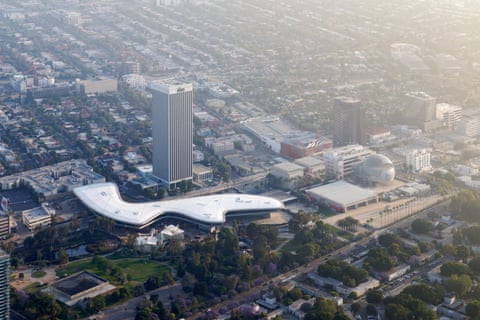
From the outside, LACMA's new building, the David Geffen Galleries, resembles a futuristic "dinosaur egg" raised on concrete supports, with a long "tail" of gallery space that crosses Wilshire Boulevard and provides entrances on both sides of the street.
Inside, massive concrete surfaces and huge windows flood the spaces with sunlight—a controversial decision for a museum. Chief Executive Officer Michael Govan defends the choice, arguing that the idea is for the collections to be "clearly in Los Angeles."
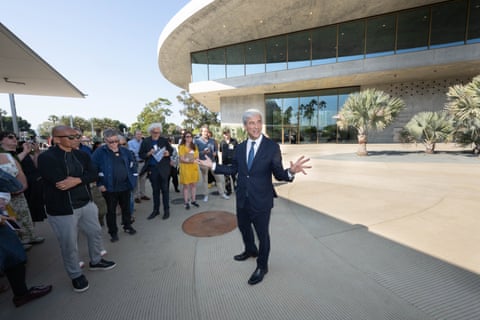
He led journalists through the winding galleries, sharing stories about architect Peter Zumthor, who was absent. Govan noted that the elegant leather benches were temporary until specially designed seats made of red-brown leather and filled with feathers arrived.
In response to criticism, he stated that the project was an "experiment" and that a true assessment would only come once the public began using it.
Resistance to Zumthor's changing design was fierce. Critics mockingly called it "the stain" and protested so strongly that they organized an alternative design competition and published full-page newspaper advertisements to express their dissatisfaction.
But for Govan, the new building is more than just a gallery. He sees it as a bold reimagining of the art experience—an attempt to "reinvent art history for the 21st century."
The concept is based on the idea of "non-hierarchy." Instead of arranging LACMA's permanent collection by era, geography, or art form, Govan tells Zumthor: "I don't want anyone in front."
This philosophy is reflected in the architecture. All gallery spaces are located on one floor, in a deliberately unpredictable layout that avoids linear routes. "The building itself really avoids linear stories or linear paths," explains Govan. "The goal was to create something like a walk in a park, where everyone curates their own journey."
When it opens in 2026, the first exhibition will follow this concept. It will be dedicated to the "muse" of the four oceans, combining Mediterranean art with a Pacific collection that will juxtapose Californian artists with Japanese artists.
Zumthor and Govan's vision also has its defenders. In 2019, actor Brad Pitt attended a public hearing where he praised Zumthor's "mastery of light and shadow" and spoke so passionately in defense of the project that an elected official ultimately told him to "wrap it up." Rather, Architectural Digest described the new LACMA building as one that offers "curatorial provocations and challenges to the dogmas of the art world."
Although journalists were polite during Friday's preview tour, their questions clearly showed that criticism of the new LACMA building continues unabated.
At the heart of the debate lies the practicality of concrete walls – a recurring concern highlighted in a series of sharp columns by art critic Los Angeles Times Christopher Knight. Knight, winner of the 2020 Pulitzer Prize for his criticism of a project partially funded by $125 million in public funds, stated back in 2019: "How are you going to hang pictures on concrete walls?" He called the idea "madness" and gave Zumthor's building the nickname "The Incredibly Shrinking Museum," noting that the planned gallery space shrinks throughout the process, resulting in the new building offering less exhibition space than the demolished old buildings.
When asked again on Friday how curators would hang art on the minimalist concrete, executive director Michael Govan was unfazed: "You can just drill the walls," he said. "They are very sturdy—you can even hang an Assyrian relief on them."
When changing exhibitions, Govan explained, new holes will be drilled and the old ones will be filled in. In fact, there were already several visible patches on the walls.
When asked whether constant drilling and filling would spoil the aesthetics of the smooth concrete surfaces, Govan replied without hesitation: "It should be like a good pair of old jeans that get even better with time."
As for the future of the museum, he was optimistic: "This building can last 500 years," he said.
–